
TL;DR: Solo consultants, executive coaches, and corporate trainers can successfully compete — and win — in the $417 billion corporate training market by leveraging five key competitive advantages over large platforms like LinkedIn Learning and MasterClass: deep customization, live interaction, experiential learning, follow-on support, and subject matter expertise. With over 56% of corporate training spend flowing to external providers and no single company controlling more than 1% of the market, boutique firms and solo experts are uniquely positioned to dominate their niche. This guide explains how to get corporate training clients by differentiating your offering, speaking directly to what corporate decision-makers actually buy, and turning one-off workshops into recurring revenue streams.
Executive coaches, corporate trainers, and consultants often ask: “How do I get corporate training clients as a solo expert?” Many think it’s about more social media presence, bigger networks, or cold outreach. While those tactics have their place, your real starting point is differentiation — knowing exactly how you stand out in a marketplace flooded with big providers and commoditized content.
For a fuller walkthrough of the strategies covered in this article, check out the YouTube video that inspired this article.
How Big is the Employee Workshop Opportunity?
According to the latest market data from Research and Markets, the corporate training market will grow from $417.53 billion in 2025 to $439.82 billion in 2026 at a 5.3% compound annual growth rate, driven by workforce expansion, employee upskilling needs (especially thanks to significant AI disruption), globalization of business operations, growing compliance requirements, and adoption of structured learning frameworks.
No single company owns more than 1% of this massive market. Even more to the point, over 56% of all corporate training spend goes to external providers — and a significant portion flows to boutique firms with under 10 trainers, including solo keynote speakers, leadership coaches, and specialized trainers.
Companies don’t disqualify you for being small; they qualify you for being specialized.
Every organization on the planet faces AI-driven reskilling pressure, creating urgent demand for training that actually moves the needle.
This isn’t theoretical — it’s a half-trillion-dollar opportunity where solo experts and boutique firms aren’t just competing… they’re dominating their niche.
5 Competitive Advantages Solo Experts & Boutiques Own
When LinkedIn Learning and MasterClass flood the market with low-cost, one-size-fits-all courses, how do you win? You lean into what only you can deliver. Here are the 5 competitive advantages that make corporate decision-makers choose you over the big platforms.
1. Deep Customization (Your Core Differentiator)
Big platforms sell generic courses “as-is” to millions of users. You do the opposite: you customize every element to make the training feel like it was built for that company alone. This includes:
- Teams/roles/departments — The same core negotiation learning module becomes “sales closing” for the sales team vs. “vendor negotiations” for procurement vs. “client retention” for account managers vs. “salary negotiations” for people managers
- Company language and culture — “We don’t call it THAT here, we call it THIS,” you adapt terminology, avoid sensitivities, mirror their internal lingo and speak
- People-assessment data — Have participants complete a DISC, Kolbe, Predictive Index, Hogan or other assessment prior to the workshop, and then use those specific results to tailor content to that particular group
- Time constraints — Condense into 90-minute accelerator sessions or expand into multiple half-day workshops that fit their calendar
- Business goals, KPIs, strategic initiatives — Tie training outcomes directly to their specific projects and work environment, such as product launches, revenue targets, new IT systems, new processes, or new teams working together
- Real-world examples and scenarios — Use their actual customer case studies, rock star internal subject matter experts (SMEs), internal challenges, anecdotes pulled from the media, and/or industry competitors as relevant examples
- Industry or sector — Change up the learning outcomes to prioritize what’s important to that particular field, such as putting an emphasis on safety when training employees in manufacturing, or putting an emphasis on confidentiality when training employees in highly regulated fields like healthcare
The result? Participants don’t just complete training — they apply it immediately. Engagement skyrockets. Perceived value triples. Decision-makers see direct ROI.
2. Live Interaction (Real Behavioral Change)
On-demand platforms deliver passive video consumption with zero accountability. You deliver live, interactive experiences that create lasting transformation:
- Real-time Q&A and polling — Answer questions on the spot, gauge comprehension live
- Small-group breakouts — Safe spaces for teams to practice skills with peers
- Hands-on exercises and role-plays — Real practice with immediate feedback
- Hot-seat coaching moments — Volunteers get live coaching while others observe and learn
- Participant presentations — Prove mastery by teaching back what they’ve learned
- Field assignments with your feedback — Post-session homework you personally review
Corporate buyers don’t care about course completion rates. They care about behavior change. Your live delivery with human-to-human interaction provides proof — and positions you as a true partner, not a vendor.
3. Experiential Learning (Emotional Memory That Lasts)
Office-based slide decks create zero emotional connection. You create memorable, out-of-environment experiences that forge group bonding and lasting recall:
- Arts-based spaces — Art studios for creativity, problem solving, and innovation
- Cooking classes — communication, teamwork and leadership when learning something new, dividing tasks and working under pressure
- Performance venues — Improv theater for adaptability, TV studios with live cameras for presence and presentations
- Historic/symbolic locations — Normandy battlefields for leadership under pressure, mountaintop retreats for vision-setting
- Sports/outdoor venues — Stadiums for peak performance, racetracks for split-second decisions, ropes/obstacle courses for trust-building
- Luxury retreats — Beachside workshops for strategic planning, mountain lodges for executive presence
- Animal-assisted learning — Horse-coaching to reveal leaders’ body language, presence, and impact in real-time
Research shows experiential learning creates emotional memory that quizzes and slides can’t touch. Groups bond. Lessons stick. New relationships formed. Your training becomes the story they tell for years.
4. Follow-On Support (Beat The Forgetting Curve)
Corporate decision-makers’ biggest complaint? The “forgetting curve.” Training feels amazing Day 1, but effects fade after 2 weeks. You solve this with comprehensive reinforcement:
- One-on-one or small-group coaching — Personal guidance for key leaders
- Learning nudges/snack content — Weekly emails, 2-minute videos, quick prompts
- Open office hours — Drop-in Q&A for real-time support
- 30/60/90-day check-ins — Progress reviews with course corrections
- Implementation support — Hands-on help rolling out new skills
- Field assignments with your feedback — Real-world practice you grade
- Mastermind groups or Slack forums — Peer accountability + your moderation
This isn’t “nice-to-have.” It’s what turns one-off workshops into repeatable revenue and positions you as their trusted training partner for years.
5. You Are The Expert In The Room (Ultimate Differentiator)
Forget facilitators reading scripts. You are the subject matter expert who built this content, refined it through dozens of real clients, and lives this work daily.
This means you can:
- Answer complex, real-time questions with depth (not canned responses)
- Pivot in the moment when the group needs a different angle or example
- Bring insights from multiple clients/industries into the room live
- Continuously learn their organization and refine future sessions
- Provide direct access to your expertise — no middlemen, no bureaucracy
Big platforms deliver pre-packaged content created years ago. You deliver bespoke wisdom customized on the spot. That’s worth 10x the price.
Why Solo Experts Win Training Contracts (The Market Reality)
In a $417B+ market growing 5.3% annually, generic platforms commoditize training while corporate buyers demand customized, measurable upskilling. Your “small” size isn’t a weakness — it’s a strategic weapon:
- No single provider owns >1% — The field is fragmented and wide open
- 56%+ goes to external providers — Not in-house L&D teams
- Boutiques/solos take significant share — Companies trust specialists over generalists
- AI reskilling urgency — Every firm needs training NOW, not generic courses
You’re not fighting giants. You’re out-specializing them.
Design Courses That Sell Repeatedly
This article covers how to differentiate yourself as a solo expert or boutique firm in the corporate training marketplace — giving you the 5 competitive advantages that beat LinkedIn Learning and MasterClass every time.
But here’s the reality: differentiation gets you in the door. Repeatable course design keeps the revenue flowing. One-off workshops trap you in feast-or-famine cycles — deliver, disappear, hunt for the next gig. Corporate clients want training ecosystems they can plug into quarter after quarter, not one-and-done events.
Now you need to learn how to actually design courses that sell repeatedly to companies — turning your expertise into scalable training products that generate recurring revenue from the same clients. Same content, delivered differently each time, customized to their evolving needs.
Next read our “Complete Guide to Selling Training Workshops to Companies.”
Ready to Land Corporate Training Clients Without Building Content From Scratch?
You’ve got the differentiation. You’ve got the competitive advantages. Now you need done-for-you, white-labeled training content you can brand as your own and deliver immediately.
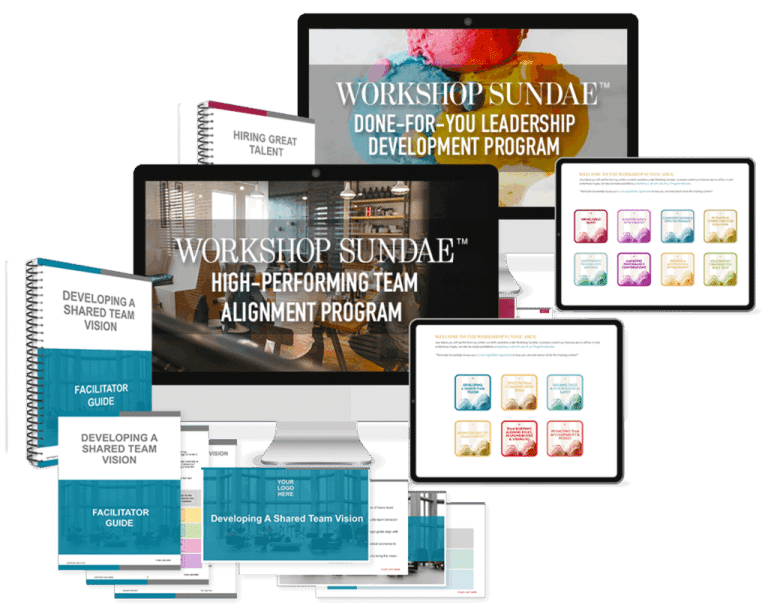
Workshop Sundae™ — BoldHaus’s white-labeled training programs that let you skip the 28-38 hour content grind per training hour and get paid for proven programs trusted by McDonald’s, Virgin America, Caterpillar, Aflac, Western Union, Philips, DISH Network, Crocs, and more.
What you get:
- 66+ hours of customizable training across leadership development, high-performing teams, and in-demand corporate topics
- Professionally designed slide decks, facilitator guides, participant workbooks — ready to deliver live or virtually
- White-label rights — Brand it 100% as yours (logo, colors, language)
- Proven with Fortune 500 clients — No risk, just results
- Mix-and-match bundles — Leadership, team alignment, or custom topic combinations
Perfect for:
- Solo experts who want corporate training revenue without content creation
- Keynote speakers scaling to repeatable workshops
- Boutique firms needing enterprise-grade materials fast
- Coaches ready to productize expertise into group programs
Imagine saving 1,848+ hours of content development time. Workshop Sundae positions you as the go-to training partner and gets you paid today — not after months of PowerPoint hell.
Start delivering premium corporate training this week:
Workshop Sundae = your unfair advantage in the $417B training market.