
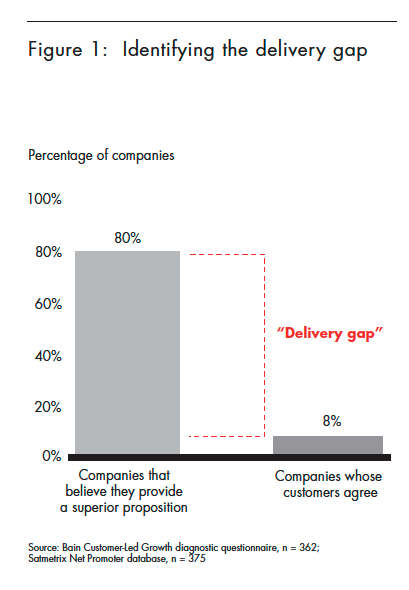
TL;DR: An astounding 81% of corporate decision makers say they are dissatisfied with the consultants, executive coaches, and service providers they hire (Forrester). Additionally, there’s a 72-percentage-point gap between what consultants think they’re delivering and what clients actually experience: 80% of consultants rate themselves as delivering “superior” value, but only 8% of clients agree (Bain & Co.).
This article looks at the top reasons why decision makers have regret, the three negative ways this impacts consultants, coaches, and service providers, and five simple yet effective ways self-employed experts and founders of boutique firms can ensure they beat the odds, being the 1 in 5 that corporate decision makers are satisfied with—naturally setting them up for stronger client lifetime value.
Here’s a sobering statistic. According to Forrester Research, 81% of decision-makers end up dissatisfied with the vendors, consultants, or service providers they decide to work with.
But as stark as that may be, it’s not all that shocking.
This data tracks with what I experienced in my corporate days — and still does in my role as a decision-maker today.
It also aligns with an older 2005 Bain & Co. study titled “Closing the Delivery Gap” that found 80% of companies believed they delivered a “superior experience” to their customers, but only 8% of customers agreed.
This gap between company self-perception and customer reality became known as the “delivery gap.” Bain & Co. “Closing the Delivery Gap”
The technical term to sum up the situation is: Oof.
That’s the sound of a broken promise. When decision-makers regret 81% of their vendor choices, and when the gap between seller confidence and buyer satisfaction is 72 percentage points, we’re not just misaligned. We’re in the wrong conversation entirely.
As a consultant, leadership coach, or service provider this is not great news for you. Here’s why.
#1. Decision-makers don’t trust you at the outset.
From the word hello, everyone — including you — is starting from a trust deficit. Decision-makers have been burned, underwhelmed, and disappointed too many times to count.
Without trust, it’s hard to close a deal. Instead, prospects will default to one of three things:
- Doing nothing;
- Doing it themselves; or
- Doing the project with an outside expert they’ve used in the past who met their expectations.
#2. Your client lifetime value will suffer.
Unless you deliver more effective solutions, build stronger relationships, and lead an elevated engagement experience compared to your competitors (of which there are many), the odds are stacked against you.
To put it bluntly: there’s a 4-in-5 chance your client will regret their choice. And regret kills retention and upselling — destroying your client lifetime value.
#3. Referrals take a hit when clients regret their choice.
For 19+ years, we’ve worked with experts who sell services to organizations. Most business owners before they come to work with us earn over 90% of their revenue from word of mouth. That’s a problem in its own right — because it means their business is at the mercy of their network and they aren’t in the driver’s seat. But we’ll address it in another article.
The point is simple: If a decision-maker regrets working with a consultant, coach, or services provider, they won’t participate in a case study, won’t give a testimonial, and — most importantly — won’t refer you to a peer. Referrals vanish.
Why Decision-Makers End Up Regretting Their Choice
Forrester’s research breaks down the actual reasons.
Buyers are not satisfied with:
- The expertise and industry knowledge providers demonstrate
- The ease and flexibility during the process
- Providers who don’t understand their specific needs and context
- “One size fits all” approaches that don’t connect their capabilities to your situation
They also want collaboration and partnership — drivers like “ease of doing business” and the vendor’s “investment to co-create or co-innovate with us.”
In other words: decision-makers regret when providers show up as vendors, not partners. When they’re generic, rigid, and checkout-focused instead of customized, collaborative, and outcome-focused.
5 No B.S. Ways to Ensure Your Corporate Clients Don’t Regret Working With You
To ensure you don’t end up with a dissatisfied corporate client you worked so hard to land, here are five no-beating-around-the-bush ways to put yourself in the 20% that corporate clients want to work with again and again.
#1. Don’t believe everything decision-makers tell you.
No, they aren’t trying to lie to you. But they may be hiding politics or dysfunction because they don’t want to scare you off, speak poorly of colleagues or their employer, or lose face.
In addition, “The fish can’t see the water.” The problem for the decision-maker is they’re in the water. They’re in the echo chamber. So they can’t always see what’s really happening — or their lens is so skewed at this point they don’t see it. They may also simply not have all the facts, or never considered them.
If you believe everything a decision-maker shares without questioning it, without looking under the hood yourself, and you design a solution based on faulty information, the engagement won’t be set up for success. And that comes back on you.
Because in the decision-maker’s mind, they told you what you needed to know. If you didn’t ask the questions you needed to ask, that’s on you.
#2. Co-create the solution — and stand firm on the nonnegotiables.
This is tough because you, of course, want to win the client. And deciding where the “line in the sand” is for any engagement is an art.
But here’s the thing: if a client asks you to repaint their office walls and insists you use a kindergartner’s watercolor palette, and you choose to move forward — that’s on you.
Similarly, if you’re compromising on something against your better judgment but haven’t clearly documented the pros, cons, and trade-offs in slides, and haven’t walked them through it on a recorded Zoom, you won’t have the receipts later to point back to.
So speak up. Be direct. And sometimes, if the client is making no sense and wants you to fly from NYC to LA without an airplane, maybe that’s not the best client to work with.
#3. Run the engagement smooth as butter.
Too many self-employed experts and boutique-firm owners get so laser-focused on individual client deliverables being exceptional that they forget to operate from a higher altitude.
You can have work product that’s exceptional and still have the engagement run off the rails.
The difference between a great deliverable and a great engagement is account management. Too many experts treat account management as administrative overhead. But it’s the backbone of client trust, retention, and upselling.
That’s why we provide our BoldHaus EDGE clients with strategic client account management templates and tools — not just checklists, but systems that elevate how they manage engagements from start to finish. When you run the engagement smooth as butter, the client doesn’t just get good work. They feel good about the entire experience. And that’s what prevents regret.
#4. Take ownership of the results, not just the deliverables.
No, the results aren’t 100% in your control. Your client’s team has to execute. Their leadership has to make decisions. Their culture has to support the change.
But your strategic “come from” is yours. Do you see this relationship as checking off deliverables in the statement of work? Or do you and your team step back with every component and ask: “What are we missing? What could drive the result better?”
More importantly: Are we measuring? Are we watching the numbers? Are we refining? Are we speaking up when something’s not moving the needle? Or are we so caught up in busyness, so in love with our solution, that we never check if the football actually moved down the field?
#5. Don’t be high maintenance.
Any time a client works with you, you’re adding more work to their plate. It’s as simple as that. But you have a lot of control over how much work you’re adding—and how annoying that extra work is.
Here are some of the ways experts show up as high maintenance:
- Asking questions they could easily find the answers to on their own
- Constantly rescheduling meetings
- Delivering work product with typos
- Delivering work with missing, outdated, inconsistent, or incorrect information
- Missing deadlines
- Firing off a slew of half-baked emails instead of getting organized first
- Writing emails as long as an encyclopedia without stating the bottom line upfront
- Not taking in new information, not thinking through moving parts and bigger context, then not adjusting accordingly
- Letting their team’s internal miscommunication or lack of coordination spill over to the client’s side of the table
Being high-maintenance makes decision-makers say, “It would have been easier to have just done this ourselves.”
Scalable Growth vs. Churn-and-Burn
At BoldHaus, we teach consultants, coaches, and service providers three facets to growing their expert-based business: Land. Expand. Scale.
Here’s what a lot of folks miss: all three elements — landing, expanding, and scaling — require three things:
- Exceptional skills at marketing, sales, and business development
- Exceptional client account management, service delivery, and maximum client lifetime value
- Exceptional management of the firm itself, particularly profitability
These aren’t three separate things. They all fuel one another.
Something else that’s often missed is that client expansion is just as much about laying the groundwork long before a client ever works with you as it is about wowing the client.
But no matter how great you are at laying the groundwork early (our BoldHaus clients report being 114% more effective at growing revenue with existing clients once they work with us), all of that good work goes right out the door if, on engagement #1, you fall into the 4-out-of-5-times regret bucket.
When 81% of decision-makers end up disappointed, you’re not just losing a client. You’re losing the expansion, the upsell, the referrals — and you’re burning the reputation that got you in the door.
That’s the difference between scalable growth and churn-and-burn.
Stand out from the noise. Convert More Sales. Keep More Profit.
INSIDE EDGE 2026 – Got your ticket yet?
Join us Oct. 12 – 16 | Fort Lauderdale
Standing out from the hyper crowded marketplace isn’t about churning out more content, having a fancy brand or killing yourself in the amount of hours you work on a client engagement.
Elevated differentiation is about how your firm is operating, top to bottom, front to back.
That’s exactly what we help you do at INSIDE EDGE. Here’s a look inside 👇
In three days, you’ll build the systems to:
✅ High-integrity lead generation that actually fills your pipeline — no chasing trends
✅ Knowing what decision-makers are already pre-sold to buy — so you stop pitching and start getting picked
✅ Knowing exactly what to say when a deal stalls or a buyer goes quiet — instead of watching another proposal vanish
✅ Turning one-and-done projects into clients who renew and expand
✅ Pricing so you’re finally paid as both the owner and the CEO
✅ The 13 Growth Systems to scale your firm — so it runs without you as the bottleneck
So instead of feast-or-famine, you finally land, expand, and scale — from the driver’s seat.
Claim your seat here: