
TL;DR: This article identifies five common sales tactics that backfire with corporate decision makers. Consultants, executive coaches, service providers and boutique firm founders should avoid: treating buyers as assistants, using fake urgency, applying one-sentence closes, hunting for pain points, and not understanding how organizations make money. Corporate buyers expect service providers to demonstrate ROI and navigate organizational complexity with multiple stakeholders. The article includes relevant data to back up what corporate decision makers are looking for during the sales cycle and the internal complexities that they face.
Corporate buyers are not impressed by pressure, scripts, or recycled sales tactics. If you want to win business from decision makers inside companies, you need to show up with more business fluency, more credibility, and a lot less performative selling.
The problem is that many tactics people copy from the marketplace are exactly the ones that make them look inexperienced to corporate clients. Decision makers inside organizations are busy, cautious, and selective. They are not looking for the person who can “close the fastest.” They are looking for someone who understands their business, respects their time, and can help them think clearly about what comes next.
That is why so many popular sales tactics backfire. They may create motion, but they often reduce trust. This matters even more for consultants, executive coaches, trainers, and boutique professional services firms, because you are not just selling a transaction. You are also selling the expertise and judgment that will shape the relationship after the sale.
Let’s take a look at the 5 bad tactics.
Prefer to watch instead of read?
Watch the full video on this topic below to see the complete breakdown of these five bad sales tactics and how to avoid them:
Bad tactic #1: Making the buyer do your job
One of the most common mistakes is treating the decision maker like your assistant.
That shows up in outreach like:
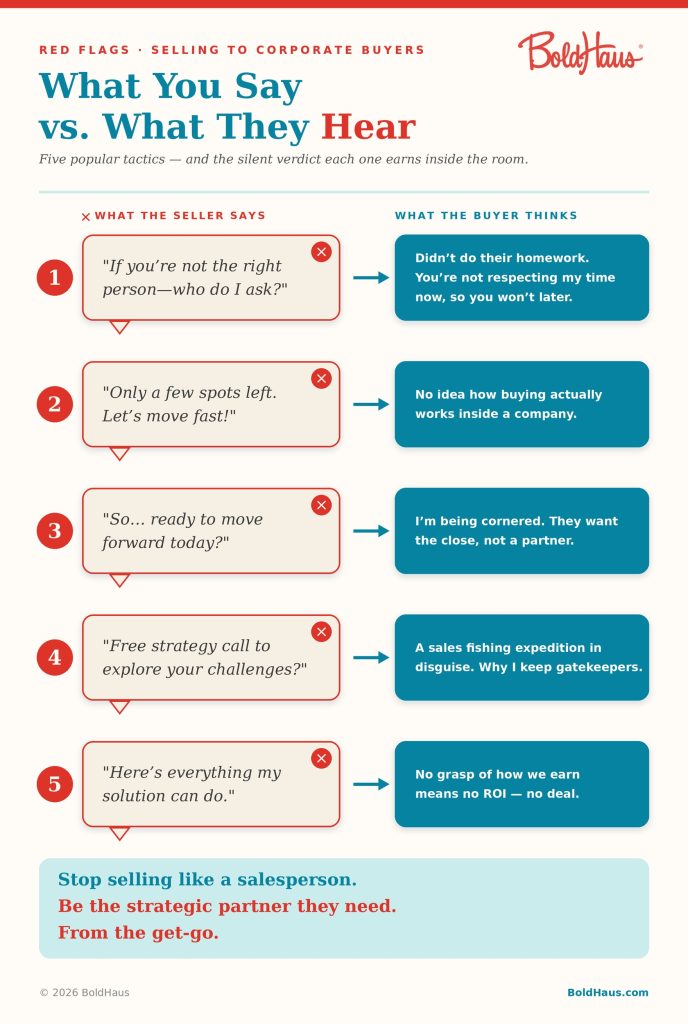
- “If you’re not the right person, who should I talk to?”
- “Can I get 30 minutes to explore your challenges?”
Those questions may seem harmless, but they shift the burden onto the buyer. Instead of showing initiative, you make the decision maker figure out your path for you.
Corporate buyers notice that immediately. It can make you seem unprepared, transactional, and overly dependent on their time.
A stronger approach is to do your homework before you reach out. Know who you want to speak to, why that person matters, and what business issue you believe is relevant.
Even better, in the BoldHaus Collective, we teach our members how to create real interactive engagement with decision makers so they want to spend time with you and discuss their challenges. By offering invitations to high-value experiences, you ensure the relationship starts out on the right path.
Bad tactic #2: Copying B2C urgency in a B2B world
A lot of sales advice is built for consumer behavior, where the buyer can decide quickly and independently. Corporate buying works completely differently.
Inside complex organizations, urgency is not set by one person. It is shaped by budgets, internal alignment, competing priorities, procurement processes, and timing across multiple stakeholders. That means the emotional triggers that work in B2C often fall flat in B2B.
The deeper issue is that using B2C tactics signals that you do not fully understand the complexity of the environment you are trying to sell into. If you do not show appreciation for that complexity in your marketing and sales process, decision makers will question whether you can effectively deliver a solution within that same complex environment.
Research supports this reality. According to Asana’s Anatomy of Work Index, knowledge workers spend 60% of their time on “work about work” — coordinating with colleagues, chasing updates, searching for information, and switching between tools — leaving only 27% for skill-based work and 13% for strategic planning.
This reflects how no meaningful project happens in isolation. Even a single task or initiative typically requires alignment across multiple departments, teams, and stakeholders before it can move forward.
That means corporate buyers are not responding to urgency triggers the way individual consumers do. They are managing internal complexity, competing priorities, and cross-functional dependencies.
When you use urgency-heavy language, overly polished social selling, or “act now” or “limited spots” messaging with a corporate buyer, it is out of sync with how they actually make decisions.
It also raises a red flag: if you do not understand their internal environment, how will you navigate it once you are a vendor?
The smarter move is to speak to the real conditions of the organization. Help the buyer think through business impact, not just next steps. Show that you understand their internal dynamics and that you can navigate them effectively.
Bad tactic #3: Using the one-sentence close
The one-sentence close is one of those old-school sales moves that sounds efficient but usually comes across as manipulative.
Questions like:
- “If I showed you how to solve this today, when would you be ready to move forward?”
- “Based on what we discussed, do you feel this solves your problem?”
These questions try to force a decision before the buyer has fully processed the issue. Corporate decision makers know exactly what is happening when that kind of pressure shows up. And once they feel cornered, trust goes down.
But the deeper problem is that the one-sentence close ignores a massive gap in almost every corporate decision: the difference between agreeing in concept and figuring out how a solution actually fits into the organization.
A decision maker can say “yes, this directionally makes sense” while still needing to figure out how it works within everything else happening in their organization.
Just some of the considerations a decision maker has to think through include:
- Current initiatives and projects already in progress
- Team bandwidth and available resources
- Competing priorities
- Budget availability and approval requirements
- What other departments or divisions may already be working on similar solutions
- IT implications and system compatibility
- Legal, regulatory or internal policy review requirements
- Upcoming C-suite strategic announcements the decision maker may not yet be aware of
- Vendor risk assessments and compliance requirements
- Integration with existing workflows and processes
- Change management and training needs
- Timeline alignment with fiscal quarters or key business cycles
When you use a one-sentence close, you are trying to rush a part of the process that cannot be rushed.
That telegraphs a clearer message than you intend: you care more about closing the transaction than about being a strategic partner who helps the decision maker navigate their organization and get things done.
Corporate buyers see that. And when they sense that imbalance, they pull back.
The better approach is to have a proven process for working with decision makers. In the BoldHaus Collective, we teach our members how to collaborate with decision makers, co-create the solution, help them build the business case internally if needed, and guide them through the steps they need to take.
Importantly, you also respect that some of these steps have to happen without you in the room. You give the decision maker space to work things out internally, but you do not just let them loose. They could overcomplicate it or spin their wheels. The balance is being helpful and collaborative, guiding without being pushy, and showing up as a partner who helps them move forward without forcing the pace.
Bad tactic #4: Hunting for pain points
In the B2B sales world, hunting for pain points is often masked as a request to “learn more about your challenges” or “see if there are synergies.” Sometimes it shows up as a “preliminary needs assessment” or “exploratory conversation.”
In the solopreneur world, it’s often painted as a “free discovery session” — a supposedly casual chat that’s really just a sales pitch waiting to happen. And even worse today, there are companies using pseudo-podcast interviews just to get them to disclose a pain point… one that will quickly be flipped into a sales pitch.
But you can put as much lipstick on the pig as you want — it’s all the same: poking a decision maker to see what hurts so the seller can pounce on them with a solution they never asked for.
Decision makers know exactly what’s going on. They’ve been through this dozens of times. They don’t like it. And it’s why they surround themselves with gatekeepers.
Not only does this chase decision makers away, but the bigger tragedy is that when you approach the landing from this angle, you never have a smooth landing.
It’s like landing the plane backwards. You might get on the runway, but you’re going to crash. You’ve established the wrong dynamic from the start, and you cannot recover from it.
It reduces you to a salesperson instead of a trusted advisor. But when you are a self-employed consultant, coach, or expert — or the founder of a boutique services firm — it’s imperative that you establish a high-trust relationship from the get-go. You need that trust in order to affect change in their organization once you are working with them.
And once we show our BoldHaus Collective members a proven process for building real credibility with decision makers, it flips the script.
Instead of you asking them for time and information, they start asking you for information.
Instead of you trying to extract pain points, they start sharing their challenges with you. The dynamic shifts from you trying to prove yourself to them evaluating whether you are worth their time. That is the difference between being tolerated and being sought out.
Bad tactic #5: Not understanding how the company makes money
This is the mistake that often exposes the biggest credibility gap.
Before you meet with any organization, you need to understand how it makes money. That applies not only to the big organizations, but to colleges, nonprofits, government agencies, startups, and mid-market companies, too. Every organization has a financial engine, even if the revenue model is not obvious at first glance.
If you walk into a meeting with a decision-maker without understanding the company’s business model, you are missing the foundation of the conversation.
The deeper issue is that organizations can’t do everything. There are always trade-offs. Decision makers are constantly weighing competing priorities, budget constraints, and the opportunity cost of choosing one solution over another. When you focus too much on how great your solution is without understanding those trade-offs, you miss the real conversation.
More to the point: Understanding how an organization makes money allows you to draw a direct line between your expertise, services, and solutions to a tangible ROI for the organization. You can show how your work will drive revenue, reduce costs, or improve efficiency in ways that align with their specific financial priorities.
That research requirement is not optional. According to Forrester’s research on the B2B buyers’ journey, more than 18,000 global business buyers surveyed indicated that vendors need to demonstrate ROI throughout the buying journey to help accelerate purchasing decisions.
That means buyers are screening for vendors who can demonstrate clear, measurable business impact. If you cannot connect your offering to how the organization makes money and what drives its financial success, you are not speaking to the core of their decision process.
Decision makers respond to people who understand their world. When you can speak intelligently about how their company operates, what drives revenue, and what success looks like financially, you sound like a strategic partner instead of just another vendor.
How avoiding these bad sales tactics sets you apart
Corporate buyers respond to professionals who show up with preparation, restraint, and judgment.
That means:
- You know the company before the meeting.
- You respect the buyer’s time.
- You avoid manipulative closes.
- You focus on business realities, not just surface-level pain.
- You communicate like someone who understands how organizations actually work.
Most people are still copying tactics that were never designed for sophisticated corporate buyers.
That is good news for you. If you stop relying on the usual formulas and start showing up with real business fluency, you immediately separate yourself from the crowd. You look more credible, more thoughtful, and more worth a second conversation.
That is especially important for expert-based businesses, where the buyer is not just evaluating your offer. They are evaluating how you think.
If you want to sell more effectively to corporate clients, focus less on looking like a classic salesperson and more on sounding like a smart business partner. Do the research, ask sharper questions, and resist the temptation to use tactics that create pressure instead of trust.
Ready to stand out with corporate decision makers?
If you are a consultant, coach, or founder of a boutique services firm and want to master selling to corporate clients, as well as scaling your firm profitably, consider attending INSIDE EDGE 2026, the world’s #1 growth summit for experts selling to corporate clients.
INSIDE EDGE 2026 takes place October 12–15, 2026, at the Westin Beach Resort in Fort Lauderdale, FL. Learn how to land bigger contracts, build stronger client relationships, and apply proven frameworks that work for expert-based businesses.