
TL;DR: The corporate training market is one of the most significant and underleveraged opportunities available to consultants, executive coaches, and professional service providers right now. AI and rapid workforce change have created urgent demand for human-skills training, and organizations are actively looking for outside experts to deliver it. This guide walks you through BoldHaus’ proven three-step plan: identifying the right decision-makers, defining the specific gap your training fills, and getting in front of buyers efficiently using the network and relationships you already have. We also cover the two biggest mistakes that can result is tremendous opportunity costs as well as real out-of-pocket expenses that are never recovered.
The corporate landscape has shifted dramatically in recent years. AI and new technologies have fundamentally changed how organizations operate, how leaders lead, and what skills their people need to stay competitive. A Deloitte report confirms that the rise of AI has driven a strategic focus on upskilling human employees in higher-level capabilities, specifically the kinds of complex, relationship-driven, judgment-intensive skills that no algorithm can replicate.
For consultants, coaches, trainers, and professional service providers, this is not a trend to watch from the sidelines. It is an open door.
The challenge most face is not a lack of expertise. It is knowing exactly how to approach the right people, articulate the right value, and turn those conversations into real, recurring engagements. At BoldHaus, we teach our clients how to do exactly that using a proven three-step plan.
This guide covers all three steps in full.
Prefer to watch? This guide is based on two videos.
Start here: How to Sell Training to Companies, Part 1.
Step 1: Target the Right Decision-Makers
Before you can sell anything, you need to get crystal clear on who actually has the authority and the budget to say yes. This sounds obvious, but it is where a significant number of coaches and consultants go wrong. They spend months in conversations with people who are interested yet powerless to approve an investment.
Who to Target for Enterprise-Wide Training
If your training covers leadership, communication, emotional intelligence, or other skills that apply across multiple departments, the decision-makers you need are the ones responsible for learning, organizational development, and people strategy. Depending on the organization, their titles may vary, but their function is consistent: they own the development of the workforce.
Look for roles such as:
- Chief Learning Officer (CLO)
- Chief People Officer (CPO)
- Chief HR Officer (CHRO)
- VP or Director of Talent Development
- VP of Learning and Development
- VP of Learning and Organizational Development
- Head of People Strategy
- Senior Manager of Organizational Effectiveness
- HR Business Partners
- Divisional Heads of HR (i.e. head of HR for XYZ business unit)
Who to Target for Specialized or Technical Training
If your training is focused on a specific function or technical discipline, the relevant decision-makers will sit closer to that department. Think:
- Department VPs, Directors, and Senior Directors
- Business Unit VPs, Directors, and Senior Directors
- Chief Information Officer (CIO)
- VP of Logistics, Engineering, or Manufacturing Operations
- VP of Customer Service
- Heads of Quality Assurance or Risk Management
- Technical Training Managers
- Plant or Facility Managers
For these roles, LinkedIn, shared industry webinars, and speaking engagements are among the most effective ways to get on their radar. Because their mandates are highly specialized, your outreach needs to speak directly to their operational priorities, not to generic training benefits.
Pro tip: Getting in front of decision makers is key. We cover this in our guide: 10 Highly Effective Ways Consultants & Coaches Find High-Value Corporate Clients.
- Which consulting services genuinely excite you
- Which client challenges you enjoy solving (and are excellent at doing so)
- Which industries you understand at a deep level
- How you want to structure your consulting business model long-term
Many consultants try to serve everyone early on. But when you understand your natural strengths and motivations, identifying the right B2B decision-makers becomes far less complicated.
Step 2: Define the Gap Your Training Fills
Once you know who you are targeting, the next step is getting clear on why an organization would choose your training over what they already have, whether that is internal programs or other external providers.
Organizations invest in outside training when there is a visible gap between where they are and where they need to be.
Your job is to identify which of the following four gaps your training addresses, and lead with that in every conversation.
Gap 1: Improved Quality and Outcomes
Decision-makers bring in outside experts when their existing programs are not delivering strong enough results. If your methodology, framework, or approach produces measurably better outcomes than what they have tried before, that is your lead.
Why they buy: Superior design and proven results. Example: Your emotional intelligence approach outperforms what their internal team has been delivering.
Gap 2: Cost Efficiency
When organizations are evaluating multiple providers, total cost and return on investment become central to the decision. If you can deliver the same or better results at a more competitive investment, that is a compelling case.
Why they buy: Premium outcomes at a smarter price point. Example: Your program delivers measurable results at a fraction of what a larger firm would charge.
Gap 3: Faster Delivery
Time away from work is a real cost for organizations. If you can condense a multi-day program into a tighter format, offer modular delivery that fits around operational schedules, or provide micro-learning options that minimize disruption, you have a meaningful advantage.
Why they buy: Less time away from core responsibilities. Example: 15 to 30 minute learning modules, or condensed half-day formats that deliver the substance of a full-day program.
Gap 4: Limited Internal Bandwidth
Many organizations know they need training but simply do not have the internal capacity to deliver it. Their HR or L&D teams are stretched, their internal trainers are unavailable, or the expertise required falls outside what they have in house.
Why they buy: You fill a void they cannot fill themselves. Example: Your specialized expertise covers a topic their internal team has neither the time nor the background to address.
Step 3: Connect With the Right Decision-Makers
Knowing who to reach and what value you bring only matters if you actually get in front of the right people. This is the step where most consultants either stall out or overcomplicate things. At BoldHaus, we consistently see that the most effective early-stage pipeline comes from three sources that most coaches are dramatically underusing.
See Step 3 in action: How to Sell Training to Companies, Part 2.
Strategy #1. Start With Companies in Your Immediate Network
Your local geography is an asset that most consultants overlook in favor of chasing clients in other cities or markets. In reality, proximity is a competitive advantage. It makes in-person meetings easier to schedule, reduces travel costs, builds familiarity faster, and makes it simpler to leverage shared connections for warm introductions.
Start by mapping the organizations within driving distance of where you live. You may be sitting closer to your ideal clients than you realize.
Strategy #2. Activate Your Existing Professional Network
In our experience working with BoldHaus clients over the last nearly 20 years, many are sitting on a gold mine of relevant connections they have never fully activated. Former colleagues, past collaborators, industry peers, and LinkedIn contacts who already know your work are among the highest-probability leads you have access to right now.
Re-engaging your existing network requires far less effort than cold outreach and produces far better results. These people already have context for who you are and what you do. The friction is lower, and the trust is already there.
Strategy #3. Reconnect With Current and Past Clients
Here is something most coaches and consultants do not account for: your existing and former clients are very likely unaware of everything you offer.
A client who hired you for executive coaching may have no idea you deliver team training. A past engagement focused on one topic may have left them completely in the dark about your broader expertise.
People cannot buy what they do not know exists. A direct, personal conversation with a current or past client about your training offerings is one of the highest-return activities available to you.
A Gartner study found that while B2B buyers often begin with independent research, they strongly prefer direct conversations when evaluating whether a solution genuinely fits their organization’s needs. You have already earned that conversation. Use it.
The Two Biggest Mistakes Consultants, Coaches & Trainers Make When Selling Training Programs to B2B Clients
Mistake 1: Building Before You Have Sold
Do not spend weeks or months developing a fully built training program before you have a signed contract in hand. Sell the engagement first, then build what you need to deliver it. This is how experienced consultants operate, and it protects you from investing significant time and energy into content that may never generate a dollar.
The outline, the learning objectives, and a compelling description of what participants will walk away with are enough to have a real sales conversation. You do not need a finished product to close a deal.
Mistake 2: Building an Online or Packaged Course Before Delivering It Live
Once you do have clients and are delivering training, resist the urge to immediately package your content into a polished online course or scalable product. Before you do that, you need live delivery experience with real participants, ideally across at least 10 to 12 different client groups.
Those live sessions are your most valuable research and development process. They show you where participants get confused, which exercises land and which fall flat, and how organizations actually respond to your approach. Without that feedback, you are packaging content that has never been stress-tested, and the result is often a product that is difficult to sell and harder to defend.
Deliver first. Package when the content has proven itself in the room.
How to Maximize Revenue From Every Training Engagement
Once you have validated your training through live delivery, the next move is shifting from single workshops to multi-session programs. A one-off workshop is a transaction. A multi-session learning journey is a partnership, and it is priced accordingly.
Think in terms of:
- Multi-session courses delivered over weeks or months
- Ongoing development programs that evolve with the organization's needs
- Structured learning journeys that span teams or departments
This approach increases your revenue per client, deepens the relationship, and positions you as a long-term strategic partner rather than a vendor who shows up once and disappears.
Skip the Content Development Grind. Start Getting Paid.
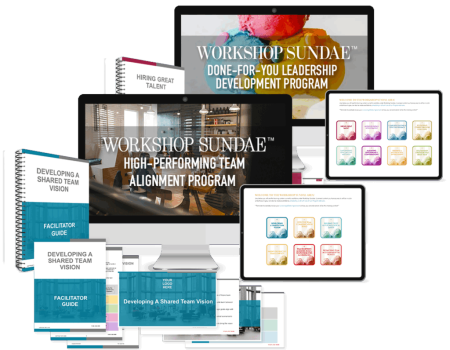
If this guide has surfaced an appetite for expanding your training offerings, but the prospect of developing all of that training content from scratch feels like a barrier, Workshop Sundae was built specifically to solve that problem.
Workshop Sundae is a BoldHaus platform offering done-for-you, white-labeled training programs that consultants, coaches, trainers, and speakers like you can license, brand, and deliver as their own. The content behind it has been trusted by global organizations including McDonald’s, Virgin America, Caterpillar, Aflac, Western Union, Philips, DISH Network, and Crocs, among many others.
Creating one hour of quality training content from scratch takes between 28 and 38 hours.
Alternatively, Workshop Sundae gives you access to 66 or more hours of fully customizable, professionally designed training content across four bundles, covering leadership development, high-performing team alignment, and mix-and-match topics in high demand right now.
Every module comes complete with all the components organizations expect from a serious outside training provider: the training presentation, participant workbook, recommended agenda, facilitator’s guide, pre- and post-surveys, coaching tip sheet, workshop description, and content evaluation. Each bundle comes with a lifetime license, meaning you invest once and monetize the content repeatedly across every client you serve.
The results Workshop Sundae licensees have seen speak for themselves. One consultant closed $40,000 in training contracts in her first year. Another generated $10,000 from a single training topic. Another built an entire yearlong leadership development program for corporate clients and estimates it saved her 500 hours of content development time.
If you are ready to stop building from scratch and start delivering programs that get you invited back, visit Workshop Sundae to explore the bundles and find the right fit for your practice.