
TL;DR: If you’re a consultant, executive coach, or trainer still offering one-off workshops to companies, you are leaving serious money on the table. This article breaks down exactly how to package your expertise into a multi-session learning journey that decision-makers are eager to invest in; what eight components every training module must include to be taken seriously; how to extend engagements with strategic add-ons; and the one phrase you should never use to describe your training, because it instantly devalues everything you offer.
If you are a consultant, executive coach, professional services provider, or trainer, you may already be delivering employee workshops to companies and organizations. That is a strong foundation.
But what we are talking about here is how to go further, how to move beyond the one-and-done workshop and into something far more valuable: a training course that keeps you working with an organization over a period of weeks, months, or even a full year.
Done correctly, this shift can dramatically boost your fees, deepen your client relationships, and create the kind of steady, recurring revenue that transforms a consulting practice.
See this in action: How To Sell Training Courses to Companies.
Why You Need to Sell Multiple Courses to Companies, Instead of Once-and-Done Workshops
Multiple courses allow you to create a learning journey with a clear destination, and that is a fundamentally different value proposition than a single workshop.
Single workshops are useful. But they often lack staying power. The real transformation happens over time, through repeated exposure, reinforcement, and application. Decision-makers who have seen that dynamic play out inside their organizations understand it intuitively. Your job is to show them that you understand it, too.
A 2026 Deloitte survey found that 85% of leaders believe developing more adaptive leadership skills is extremely important in today’s fast-paced environment. You might think to respond to that with a single workshop on leadership. But a more strategic and far more compelling approach is to propose a full talent development cycle: a cohesive, modular program that takes leaders through the full arc of what it means to lead effectively.
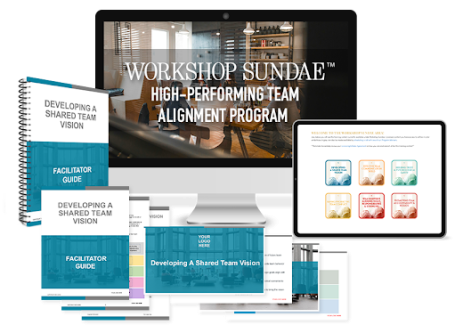
At BoldHaus, we offer exactly this kind of program through our Workshop Sundae platform, which allows coaches and consultants to license our content to sell to their corporate clients. And the way we’ve designed this program provides a lot of insights.
One example we can look at is our eight-part leadership development learning journey that covers the complete talent development cycle. Here is the eight-part journey:
Hiring great talent
Providing clear expectations and feedback
Coaching to influence and develop
Leading effective and empowering one-on-ones
Managing difficult performance conversations
Building a motivational and inclusive environment
Practicing relationship strategies that build trust
Collaborating to set and align goals
Yes, each of these eight topics could stand alone as a half-day workshop.
But together, they form a program that transforms leaders into top performers and positions you as an indispensable long-term partner, not a one-time vendor.
Why Your Training Course Must Be Flexible, Scalable, and Modular
For your training course to be viable in a B2B context, it needs to be adaptable. When you present to a decision-maker, you need to demonstrate that your program bends to their organization’s needs rather than forcing them into a rigid structure.
In practice, that means:
- Topics can be delivered in different sequences depending on what the organization wants to prioritize
- Individual modules can be removed without disrupting the overall integrity of the learning journey
- The course can be adjusted to reflect specific sensitivities or areas the organization feels are already well covered internally
That last point matters more than most consultants, coaches and experts realize. If a client tells you a particular topic feels too sensitive or redundant, and your program cannot accommodate that, it becomes a barrier to closing a sale. A modular design removes that barrier entirely. You are not asking them to accept an all-or-nothing solution. You are inviting them to shape a program that works for their people.
The 8 Essential Components of a Successful Training Module
Here is where many consultants, trainers, and coaches underestimate what it takes to command a premium. Decision-makers at serious organizations have expectations. They have seen polished, professional training programs before, and they will measure yours against that standard.
At BoldHaus, through our WorkshopSundae.com platform, we have identified eight components that every training module must include:
1. Training Presentation
This is your core delivery material, whether you are in a conference room or on Zoom. Polished, professional slides are non-negotiable. They are table stakes, but they are only the beginning.
2. Participant Workbook
This is not the slides printed as a PDF. A real participant workbook includes learning objectives, guided exercises, and additional resources participants can use during and long after the session ends.
3. Recommended Agenda
This serves two purposes. It keeps your own delivery consistent, especially if you bring in other facilitators or offer train-the-trainer options. And it helps your client understand exactly what to expect, when breaks happen, and how the day is structured. Consistency of experience is what gets you invited back.
4. Facilitator’s Guide
More and more companies want to be involved in delivering training, not just receive it. A facilitator’s guide makes co-facilitation possible, supports any team members you bring in, and enables train-the-trainer arrangements. Without it, you are creating a bottleneck around yourself.
5. Pre- and Post-Surveys
These surveys measure participant progress before and after the training, giving employees a tangible sense of how far they have come. More importantly for you, they generate the metrics and data you need to have powerful follow-up conversations with decision-makers about what comes next and to demonstrate ROI when pursuing future engagements.
6. Coaching Tip Sheet
Every employee sitting in your workshop has a manager. That manager likely was not in the room with them. The coaching tip sheet gives those leaders concrete guidance on how to reinforce the behaviors and mindsets you introduced, so the learning does not evaporate the moment the session ends.
7. Pre-Written Workshop Description
This one is underestimated by almost everyone. If you do not give the organization a clear, well-crafted description of your training to share with employees ahead of time, you have no control over how it gets communicated. Leaders will improvise. Employees will show up with no idea what to expect, or worse, with the wrong expectations entirely. Hand them the language. It protects your intent and sets the stage for a better experience.
8. Content and Trainer Evaluation
A formal evaluation captures measurable feedback from participants. This data is gold. It fuels your marketing, strengthens your credibility with new prospects, and gives you the foundation for a compelling post-training strategic debrief with the decision-maker, which is where your next engagement begins.
Together, these eight components signal to decision-makers that your training is not a side project. It is a professional, scalable, repeatable program built for organizations that take development seriously.
How to Extend Engagement With Strategic Add-Ons
Once your core training is in place, strategic add-ons deepen the value for participants and extend your time inside the organization. The more time you spend with a client, the more you learn about what else they need, and the more naturally your next engagement emerges.
Consider offering:
Learning snacks or nudges: Short emails or micro-content sent to participants weekly for 9 to 12 weeks after the training to reinforce key concepts
One-on-one coaching: With you or members of your bench, for participants who want individualized support
Peer labs or roundtables: Structured sessions for participants to reflect, ask questions, and share what they are applying
Manager integration sessions: Bringing the direct managers of participants into the conversation so they can support and reinforce the learning
Assessments: Tools like the Kolbe, Hogan, or DISC assessments that add another dimension to the learning experience
These extensions can be bundled into a tiered statement of work with corresponding pricing, positioning you as a strategic partner invested in long-term outcomes, not a trainer who shows up, delivers, and disappears.
The One Term You Should Never Use When Selling Training Courses
We have saved this for last because it matters, and because we see coaches and consultants make this mistake constantly.
Never ever call your training a “lunch and learn.”
Not even if a client suggests it. If a client says, “We’d love for you to come in and do a lunch and learn,” you can smile and say: “We don’t do lunch and learns, but we do power lunches,” or “We do 90-minute accelerators,” or whatever language fits your brand.
The phrase “lunch and learn” conjures a brown bag, a folding table, and a session that competes with people checking their phones over a sandwich. Whatever your expertise is, it is worth exponentially more than that framing implies.
You have spent years, likely decades, developing what you know and learning how to transfer it to adult learners inside complex organizations. Name it accordingly. Give your programs titles that reflect their transformative value and command the pricing that matches.
But whatever you do, do not call it a lunch and learn.
Skip the Content Grind. Start Delivering and Getting Paid.
If this article has you thinking about the training programs you could be selling, but the idea of building all of this content from scratch feels overwhelming, we have a solution worth knowing about.
Workshop Sundae is a BoldHaus platform offering done-for-you, white-labeled training programs that consultants, coaches, trainers, and speakers like you can license, brand, and deliver as your own. The content has been trusted by global brands including McDonald’s, Virgin America, Caterpillar, Aflac, Western Union, Philips, DISH Network, Crocs, and many more.
Keep this in mind: Creating just one hour of quality training content takes between 28 and 38 hours.
But Workshop Sundae gives you access to 66 or more hours of ready-to-go, customizable training across four bundles, covering leadership development, high-performing team alignment, and mix-and-match hot topics in high demand right now.
Every module comes complete with all eight components described in this article: the training presentation, participant workbook, recommended agenda, facilitator’s guide, pre- and post-surveys, coaching tip sheet, workshop description, and content evaluation. It is a lifetime license, meaning you invest once and monetize it again and again with every client you serve.
One Workshop Sundae licensee closed $40,000 in training contracts in her first year. Another made $10,000 from a single topic. Another built an entire yearlong leadership development program for corporate clients, saving what she estimates would have been 500 hours of content development time.
If you are ready to stop building training content from scratch and start delivering programs that get you invited back, visit workshopsundae.com to explore the bundles and find the right fit for your practice.