
Just as you wouldn’t paint a house with a toothbrush, selling your services to corporate clients as a consultant or executive coach requires a different approach. What has worked for you before with smaller clients rarely translates well when talking with decision makers inside big organizations.
In this article, you’ll learn exactly how to sell to corporate clients, including the common pitfalls that block small business owners, the three key challenges you’ll face, and practical strategies to get in front of the right executives without feeling “salesy” (which, let’s be honest, no one wants to feel). By the end, you’ll understand how to position yourself as a trusted expert and build lasting corporate relationships that grow your business.
Why Is Selling to Corporate Clients Different?
Many consultants assume that online marketing tactics that worked for individual clients will work the same in organizations. But the truth is that they don’t. In the marketing world, there is a difference between a “tomato” and “tomato”.
Corporate decision makers operate in complex environments with competing priorities, internal politics, and layers of gatekeeping. Instead of hunting for a magic bullet, focus on understanding the structural challenges that define this marketplace.
To make these ideas more concrete, I’ve broken them down in a short video where I walk through the exact challenges and strategies that help consultants and coaches succeed with corporate clients.
Challenge #1: You Don’t Have Enough Decision Makers in Your Universe
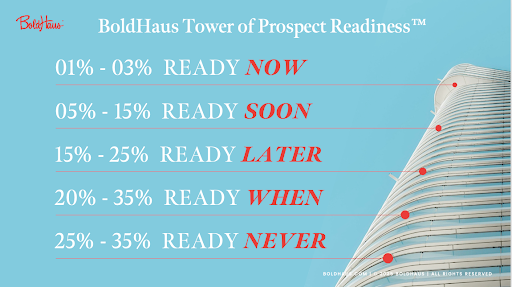
Here’s a hard truth: Only 1% to 3% of your ideal corporate clients are actively ready to buy at any moment, which you can see in the BoldHaus’ proprietary prospect readiness pyramid image below. If your visibility reaches only a handful of executives, your chance of landing a contract is tiny.
Many consultants feel visible online, but posting consistently on social media doesn’t equate to being seen by the people who hold the budget.
✅ What to do instead:
- Cast a broader net by joining industry associations and professional networks.
- Seek speaking opportunities, webinars, and guest articles on platforms that already have your target audience.
- Build relationships with centers of influence who are trusted by decision makers.
Challenge #2: By Default, They Don’t Want to Talk to You
This isn’t personal. Decision makers avoid conversations for three main reasons:
- They are overbooked. Many spend most of their workweek in meetings.
- They dislike sales conversations. Aggressive pitches erode trust.
- They assume they don’t need you yet. Often, the ideal time to engage is long before a crisis, but they don’t see it that way.
✅ What to do instead:
- Avoid the generic “nurture sequence” approach. No executive wants another newsletter clogging their inbox. As stated, corporate clients are busy. They do not want to spend their time listening to generic advice.
- Engineer reasons for them to engage through bridge strategies:
- Strategic debriefs
- Insights briefings on industry changes
- Assessments that give them immediate value
Challenge #3: When You Finally Get the Meeting, You Have the Wrong Conversation
A common mistake is immediately asking questions that poke at pain points, hoping to land a sale. Decision makers can feel this a mile away and immediately become defensive and withhold information. It can also make you feel overtly aggressive. And when you feel pushy and awkward, your prospects can feel that, too.
Keep in mind that you haven’t yet established trust, so starting with “pain hunting” can backfire. We recommend checking out our guide, “5 No-Brainer Reasons Never to Give Consulting Clients a Proposal with 3 Different Options” for a more in-depth discussion.
✅ What to do instead:
- Align your conversation with their current priorities:
- Urgent: Focus on alignment and clarity.
- Near-term: Offer perspective and insight.
- Exploratory: Educate and influence thinking without pressure.
How Do You Reach Decision Makers in Organizations?
Despite what you may have heard, content is not king when selling services to mid-market companies. It doesn’t matter how visible you are to the world if you are not seen by those you want to work with. Remember: Decision makers aren’t scrolling social feeds for consultants. They consume information from trusted, established sources, such as:
- Industry associations
- Professional organizations
- High-credibility publications
- Roundtables and peer networks
Actionable steps:
- Guest post on authoritative publications.
- Speak at association events or webinars.
- Join industry roundtables or panels.
This type of visibility positions you as credible without the fluff.
Engineer Reasons Executives Actually Say ‘Yes’ To
Because corporate buyers aren’t naturally seeking outside experts, you must create compelling reasons to meet. Some great ways to do this are by building:
- Assessments and audits
- Strategic insights briefings
- Industry trend analyses
Notice what these are not: disguised sales calls.
💡 Expert Tip: According to 2025 research by Fellow, C-suite executives typically spend 28.3% of their workweek, or just over 11 hours, solely on meetings. Use this insight to design concise, actionable bridge strategies that directly address their priorities.
Match Their Readiness Level
Once in the room, your goal is to guide (emphasis on the word, guide, not force) the conversation according to their decision-making stage.
- Urgent: Focus on alignment and immediate next steps.
- Near-term: Provide clarity and perspective.
- Exploratory: Educate and influence thinking without pressure.
Matching these types of enterprise sales conversations builds trust and positions you as a strategic partner, not just another vendor.
What Are the Best Strategies for Growing Your Corporate Client Base as a Consultant?
Breaking into corporate accounts is about strategy and building trust with the right decision makers. By broadening your visibility, engineering compelling reasons for executives to meet with you, and tailoring your conversations to their readiness level, you position yourself as a credible, strategic partner rather than just another vendor.
The key is to be thoughtful and patient, so when the opportunity arises, you’re the consultant or coach they turn to. Start small, focus on influence over volume, and gradually expand your reach within organizations to create lasting impact.
If you want to learn more, download our free guide: The Million Dollar+ Boutique Firm Quick Start Guide.
Inside, you’ll learn how to:
- Expand your network of decision makers
- Build enterprise-level influence
- Navigate the nine differences between B2C and B2B markets
- Master high-level conversations that close long-term corporate work
Download the guide here: wincorporateclients.com